
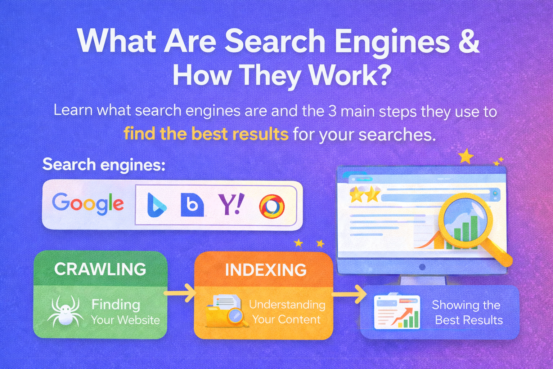
what are search engines and How Search Engines Work.
Have you ever wondered what are search engines and what actually happens when you type a query into Google and hit enter?
Within seconds, millions of web pages are scanned, analyzed, and ranked to show you the most relevant results.
This process might feel magical, but it follows a clear system. In this beginner-friendly guide, I’ll explain how search engines work in simple language—no technical overload, no confusing jargon.
What Is a Search Engine?
A search engine is a tool that helps users find information on the internet.
Popular examples include:
- Bing
- Yahoo
- DuckDuckGo
Among these, Google dominates the search market, which is why most SEO strategies focus on it.
Search engines aim to deliver the best, most relevant, and most useful results for every search query.
How Do Search Engines Work? (3 Main Steps)
Search engines work in three major stages:
- Crawling
- Indexing
- Ranking
Let’s break each step down.
1. Crawling: Discovering Web Pages
Crawling is the first step where search engines find new and updated content.
How Crawling Works
- Search engines use bots called crawlers or spiders
- These bots visit web pages by following links
- They move from one page to another across the internet
If your website has:
- Internal links
- External backlinks
- A sitemap
…it becomes easier for search engines to discover your pages.
📌 SEO Tip:
If a page isn’t crawled, it won’t appear in search results.
2. Indexing: Storing and Understanding Content
Once a page is crawled, the next step is indexing.
What Is Indexing?
Indexing means:
- Analyzing page content
- Understanding text, images, headings, and keywords
- Storing the information in a massive database (called the index)
Search engines look at:
- Page title and meta description
- Headings (H1, H2, H3)
- Keywords and topic relevance
- Images and alt text
- Content quality and structure
📌 SEO Tip:
Well-structured, clear, and original content gets indexed more accurately.
3. Ranking: Showing the Best Results
Ranking is where the real competition begins.
When someone searches for a query, search engines:
- Scan their index
- Compare hundreds of ranking signals
- Display results in order of relevance and quality
Key Ranking Factors (Simplified)
Search engines consider factors like:
- Content relevance to the search query
- Page quality and usefulness
- Keywords usage (natural, not stuffed)
- Page loading speed
- Mobile-friendliness
- Backlinks from trusted websites
- User experience and engagement
The goal is simple:
👉 Show the most helpful page at the top.
How Search Engines Understand User Intent
Search engines don’t just match keywords — they try to understand what the user actually wants. This happens in four key steps.
1. Analyzing the Search Query
First, the search engine looks closely at what the user types.
It analyzes:
- Keywords and phrases
- Word order
- Spelling and language
This helps the search engine figure out whether the user wants information, a product, or a specific website.
2. Understanding Search Intent Type
Next, the search engine identifies the intent behind the query, such as:
- Informational (learn something)
- Navigational (find a website)
- Transactional (buy or take action)
This step helps decide what type of content should appear in results.
3. Context & User Behavior Signals
Search engines also consider context, including:
- Location
- Device type (mobile or desktop)
- Past search behavior (to some extent)
This helps personalize results and show more relevant pages.
4. Matching Results to Intent
Finally, the search engine:
- Compares intent with indexed pages
- Ranks content that best satisfies the user’s need
- Shows the most helpful and relevant results first
Pages that clearly answer the query usually rank higher.
Quick Summary
- Search engines read the query
- Identify what the user wants
- Use context and signals
- Show the best matching results
Understanding user intent is key to creating content that ranks and truly helps readers.
Why SEO Matters for Search Engines
SEO (Search Engine Optimization) helps search engines:
- Crawl your site easily
- Understand your content clearly
- Rank your pages higher for relevant searches
Good SEO benefits:
- Search engines
- Website owners
- Users
When SEO is done right, everyone wins.
Common Reasons Pages Don’t Rank
If your page isn’t showing up in search results, it might be because:
- The page isn’t indexed
- Content is thin or copied
- Keywords are missing or overused
- Poor internal linking
- Slow website speed
- Not mobile-friendly
Fixing these basics can significantly improve visibility.
Final Thoughts
Search engines aren’t mysterious machines—they’re systems designed to organize the internet and help users find answers.
To summarize how search engines work:
- Crawling finds your content
- Indexing understands and stores it
- Ranking decides where it appears
If you focus on helpful content, clear structure, and user experience, search engines will naturally favor your site.
[…] promote your business, or share your ideas with the world, you have to have online presence on search engine and creating a website is one of the best decisions you can make. Luckily, building a site today is […]
[…] you use a search engine like Google or ask an AI assistant for help, there’s a powerful process working quietly behind […]
[…] SEO may sound complicated, but it’s really about helping search engines access, understand, and index your website properly. Without strong technical SEO, even the best […]
[…] research = finding the exact words and questions people type into Google every day — and then writing articles that answer those questions better than anyone […]