
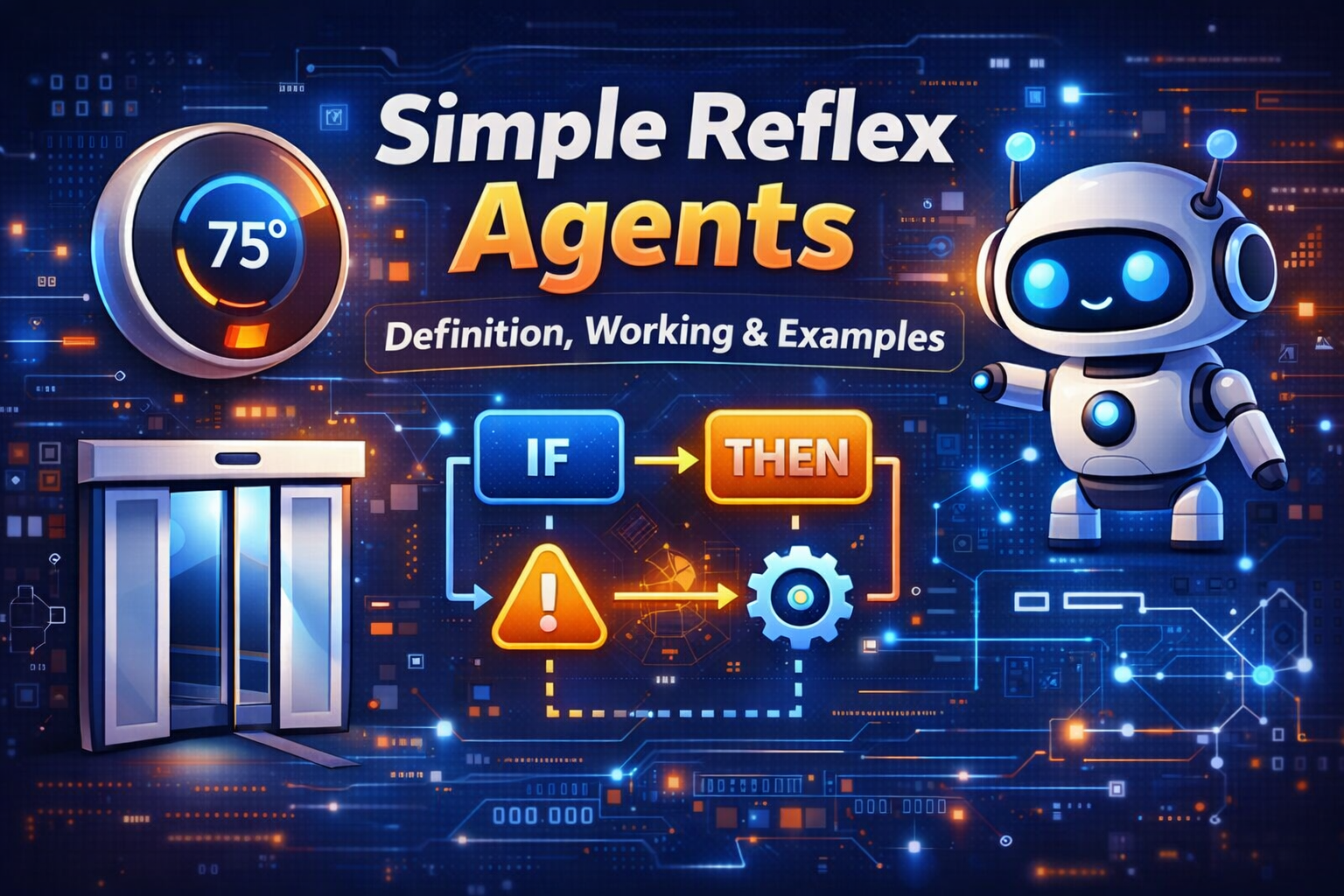
If you’ve ever wondered how some AI systems react instantly without thinking too hard—like a thermostat turning on the heat the moment it gets cold—you’re already halfway to understanding Simple Reflex Agents in AI.
These are one of the most basic yet surprisingly useful types of intelligent agents in AI. They don’t plan, they don’t remember the past, and they don’t dream about the future. They just look at what’s happening right now and respond according to fixed rules. In this 2026 guide, we’ll break down exactly what Simple Reflex Agents are, how they work, real-world Simple Reflex Agents examples, how they compare to other types of AI agents, and why they still matter in modern artificial intelligence agents.
Whether you’re studying AI decision making agents, preparing for an exam, or just curious about how AI behaves in simple environments, you’ll walk away with a clear picture. Let’s dive in!
What Are Intelligent Agents in AI?
Before we talk about Simple Reflex Agents, let’s set the stage with a quick overview of intelligent agents in AI.
An intelligent agent is anything that:
- Perceives its environment through sensors (cameras, temperature readings, user input, etc.)
- Takes actions through actuators (motors, speakers, sending messages, etc.)
- Aims to achieve some goal or perform well
There are several types of AI agents:
- Simple Reflex Agents
- Model-based Reflex Agents
- Goal-based Agents
- Utility-based Agents
- Learning Agents
Today we’re focusing on the simplest (and often the fastest) member of the family: Simple Reflex Agents in AI.
Definition: What Are Simple Reflex Agents in AI?
A Simple Reflex Agent is the most basic type of artificial intelligence agent. It makes decisions using only:
- The current percept (what it senses right now)
- A set of condition-action rules (if this → then do that)
That’s it .with out memory. internal model of the world. planning. or evaluation of future consequences.
In plain words:
If condition X is true right now → perform action Y.
This makes Simple Reflex Agents extremely fast and computationally cheap—but also very limited.
They work beautifully in fully observable, deterministic environments where the right action depends only on the current situation.
How Do Simple Reflex Agents Work? (The Core Mechanism)
The internal structure of a Simple Reflex Agent is beautifully simple:
- Percept → enters through sensors
- Condition-action rules (also called if-then rules or production rules) → a fixed lookup table
- Action → selected rule fires → agent acts immediately
There is no “thinking” step. No “what if I do this later?” reasoning.
Pseudocode looks like this:
function SimpleReflexAgent(percept):
    state = interpret_input(percept)          # optional simple processing
    rule = match_rule(state, rules)           # find matching condition
    action = rule.action
    return action
That’s the entire decision-making loop of Simple Reflex Agents function in AI.
Real-World Simple Reflex Agents Examples
Let’s look at some practical Simple Reflex Agents examples you already interact with every day.
1. Thermostat (Classic Textbook Example)
- Percept: current room temperature
- Rule: IF temperature < 22°C THEN turn heater ON
IF temperature ≥ 22°C THEN turn heater OFF - No memory of yesterday’s temperature. No prediction of tomorrow.
2. Spam Email Filter (Basic Version)
- Percept: incoming email content
- Rule: IF contains words “viagra”, “lottery”, “free money” THEN mark as spam
- Very fast, no context of previous emails.
3. Vacuum Cleaner Robot (Early Models)
- Percept: dirt sensor reading
- Rule: IF dirt detected THEN suck
IF bumper hit THEN turn left/right - No map, no memory—just react.
4. Basic Chatbot Greeting Response
- Percept: user says “hi”
- Rule: IF input contains “hi” or “hello” THEN reply “Hello! How can I help?”
5. Traffic Light Controller (Fixed Timing)
- Percept: timer reached end of phase
- Rule: IF green phase over THEN switch to yellow → red
These Simple Reflex Agents examples show how powerful rule-based instant reactions can be when the environment is predictable.
Advantages of Simple Reflex Agents in AI
Even in 2026, Simple Reflex Agents are still widely used because:
- Extremely fast response time (no planning delay)
- Very low computational cost
- Easy to design, debug and verify
- Predictable behavior (great for safety-critical systems)
- No need for memory or complex world model
They shine in environments that are:
- Fully observable
- Deterministic
- Episodic (actions don’t affect future percepts much)
- Static (environment doesn’t change while agent is deciding)
Limitations & When Simple Reflex Agents Fail
They struggle badly when:
- Environment is partially observable → can’t see everything
- Actions have long-term consequences → no planning
- Environment changes while deciding → too slow to adapt
- Multiple conflicting goals exist → no way to prioritize
Classic failure example:
A reflex-based vacuum that turns when it hits a wall can get stuck forever in a corner oscillating between two walls. A goal-based or utility-based agent would eventually try something different.
This is why more advanced AI decision making agents (model-based, goal-based, utility-based) were invented.
Comparison: Simple Reflex vs Other Types of AI Agents
| Agent Type | Memory? | Planning? | Handles Uncertainty? | Best Environment | Example |
|---|---|---|---|---|---|
| Simple Reflex | No | No | No | Fully observable, static | Thermostat, basic spam filter |
| Model-based Reflex | Yes | No | Partial | Partially observable | Modern vacuum with dirt map |
| Goal-based | Yes | Yes | Yes | Complex search problems | GPS navigation |
| Utility-based | Yes | Yes | Yes | Multiple conflicting goals | Self-driving car route choice |
| Learning | Yes | Yes | Yes | Unknown environments | AlphaGo, ChatGPT |
Simple Reflex Agents are the foundation — fast and cheap, but limited.
When Should You Use Simple Reflex Agents in 2026?
Even today, they are perfect for:
- Low-power IoT devices (smart bulbs, motion sensors)
- Real-time embedded systems (ABS brakes in cars)
- High-speed network packet filters
- Simple game AI (NPCs that just chase or flee)
- Fail-safe backup systems
They’re not “stupid” — they’re optimized for speed and simplicity.
Conclusion: Simple Reflex Agents Still Matter in Modern AI
So, what have we learned about Simple Reflex Agents in AI?
They are the fastest, simplest, and most efficient type of artificial intelligence agents when the environment is predictable and fully observable. They use straightforward condition-action rules to make instant decisions without memory, planning, or evaluation.
While they’re outclassed by goal-based, utility-based, and learning agents in complex scenarios, Simple Reflex Agents remain essential building blocks in real-world systems — from your home thermostat to industrial safety controls.
Understanding Simple Reflex Agents gives you the foundation to appreciate more advanced AI decision making agents and intelligent agents in AI. They remind us that sometimes the smartest solution is the simplest one.
Thanks for reading! If you enjoyed this beginner-friendly guide to Simple Reflex Agents, drop a comment below — which example surprised you the most?
(Word count: ~1510)
FAQ – Simple Reflex Agents in AI
What is a Simple Reflex Agent in AI?
A Simple Reflex Agent is the most basic type of intelligent agent in AI that makes decisions based only on the current percept using fixed condition-action rules.
What are some common Simple Reflex Agents examples?
Thermostats, basic spam filters, early robot vacuums, and fixed-cycle traffic lights are classic Simple Reflex Agents examples.
How do Simple Reflex Agents differ from other types of AI agents?
Unlike model-based, goal-based, utility-based, or learning agents, Simple Reflex Agents have no memory, no planning, and no evaluation of future outcomes.
What is the main function of Simple Reflex Agents in AI?
The Simple Reflex Agents function in AI is to map current percepts directly to actions using if-then rules, enabling very fast reactions in simple environments.
Are Simple Reflex Agents still used in modern artificial intelligence agents?
Yes! They are still widely used in low-power devices, real-time safety systems, and as components inside more complex artificial intelligence agents.
Got questions about Simple Reflex Agents or other types of AI agents? Ask below — happy to help! 🚀
[…] Simple Reflex Agents: These react based on current perceptions only. Like a thermostat turning on heat when it’s cold—no planning involved. […]
[…] 1. Simple Reflex Agents […]
[…] Simple Reflex Agents – Pure reaction, no memory […]
[…] Simple Reflex Agents […]