

Artificial Intelligence systems must constantly make decisions by exploring possible solutions. But how do they choose the best path? This is where search algorithms in AI come into play.
Many beginners struggle to understand the difference between Uninformed vs Informed Search in AI especially when concepts like BFS, DFS, and A* come into play.
In this complete guide, you’ll learn everything in a simple, practical way — with examples, comparisons,
These algorithms are the backbone of intelligent decision-making in artificial intelligence. They systematically explore possible paths (states) to find the best way from a starting point to a goal.
Table of Contents:
- What search algorithms in AI really are and how they work
- What uninformed search algorithms in AI are
- What informed search algorithms in AI are
- The key difference between uninformed and informed search algorithms
- All the main types of both (with real Python code, step-by-step explanations, pros/cons, and 2025 examples)
- When to use each type in real projects
Whether you’re a student, developer, or just AI-curious, this post will give you a complete, practical understanding. Let’s dive in!
What Are Search Algorithms in AI and How Do They Work?
Search algorithms in AI are systematic methods that explore a problem space (represented as a graph or tree) to find a path from an initial state to a goal state.
Think of it like this: You’re standing at the entrance of a giant maze. Your goal is the exit. Every corridor is a possible action. A search algorithm tries different paths until it finds the exit — ideally the shortest, cheapest, or most efficient one.
Core Components of Every Search Algorithm
Every search algorithm in AI has these three essential parts:
- State Space – All possible configurations of the problem
- Initial State – Where we start
- Goal Test – A way to check “Have we reached the target yet?”
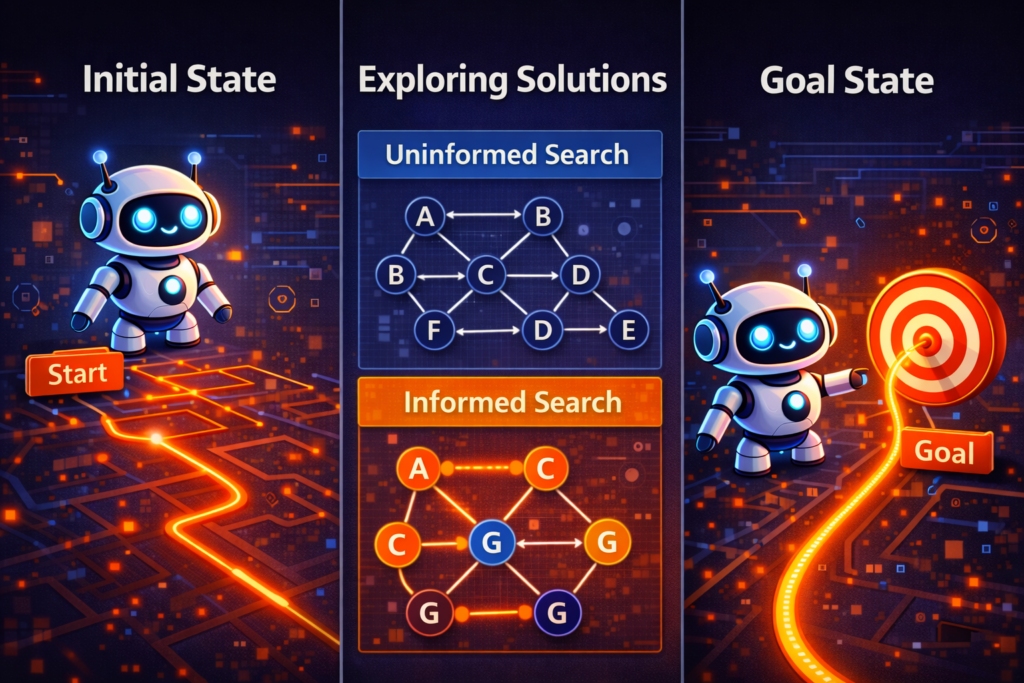
The algorithm keeps expanding nodes (states) until it finds a goal or exhausts the space. It uses two main data structures:
- Frontier (open list) – Nodes waiting to be explored
- Explored set – Nodes already visited (to avoid loops)
Search algorithms are divided into two big families:
- Uninformed Search (Blind Search)
- Informed Search (Heuristic Search)
We’ll explore both in depth below.
What Are Uninformed Search Algorithms in AI?
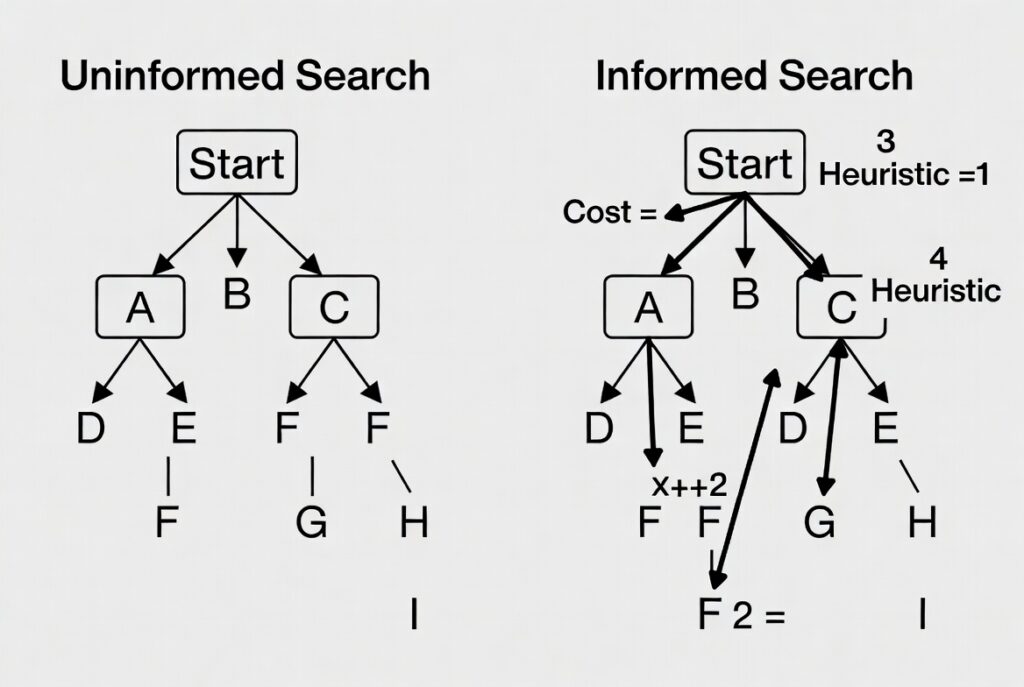
Uninformed search algorithms in AI (also called Blind Search) explore the search space without any extra domain-specific knowledge. They treat every path equally and rely only on general rules like “go deeper” or “expand lowest cost first.”
They don’t know which direction is “better.” They just keep trying paths until they stumble upon the goal.
Why Are They Called “Uninformed”?
Because they have zero heuristic (smart guess) about how close a state is to the goal. They work like someone exploring a dark room with only a flashlight — they can see only the immediate next step.
Key Characteristics:
- No prior knowledge of the problem domain
- Complete and optimal only under certain conditions
- Usually very simple to implement
- Can be extremely slow in large search spaces
Now let’s look at the main types.
Main Types of Uninformed Search Algorithms
1. Depth-First Search (DFS)
How DFS Works:
It goes as deep as possible along each branch before backtracking. It uses a stack (or recursion).
Real Python Code Example:
def dfs(graph, start, goal, visited=None):
    if visited is None:
        visited = set()
    visited.add(start)
    if start == goal:
        return [start]
    for neighbor in graph[start]:
        if neighbor not in visited:
            path = dfs(graph, neighbor, goal, visited)
            if path:
                return [start] + path
    return None
Pros: Very low memory usage
Cons: Not complete (can get stuck in infinite loops), does not guarantee shortest path
2026 Example: Used in procedural maze generation for video games and some robot exploration tasks.
2. Breadth-First Search (BFS)
How BFS Works:
It explores all nodes level by level using a queue.
Real Python Code:
from collections import deque

def bfs(graph, start, goal):
    queue = deque([[start]])
    visited = set([start])
    while queue:
        path = queue.popleft()
        node = path[-1]
        if node == goal:
            return path
        for neighbor in graph[node]:
            if neighbor not in visited:
                visited.add(neighbor)
                queue.append(path + [neighbor])
    return None
Pros: Complete + finds shortest path (when all costs are equal)
Cons: Very high memory usage in deep trees
2026 Example: Shortest-path routing in navigation apps when all roads have similar cost.
3. Uniform Cost Search (UCS)
How UCS Works:
Like BFS but considers different path costs. Always expands the lowest-cost path first using a priority queue.
Pros: Optimal even with varying costs
Cons: Can be slow when many low-cost paths exist
2026 Example: Delivery drones choosing routes that minimize battery consumption.
What Are Informed Search Algorithms in AI?
Informed search algorithms in AI (also called Heuristic Search) use extra knowledge — called a heuristic — to guide the search intelligently toward the goal.
A heuristic is a smart “guess” about how close a state is to the goal. It makes the search much faster and more efficient.
Why Are They Called “Informed”?
Because they have domain-specific knowledge (the heuristic) that helps them avoid exploring useless paths.
Key Characteristics:
- Use heuristic function h(n) to estimate cost to goal
- Much faster than uninformed search in large spaces
- Can be optimal if the heuristic is admissible (never overestimates)
Main Types of Informed Search Algorithms
1. Greedy Best-First Search
How it Works:
Always expands the node that appears closest to the goal (only looks at h(n)).
Pros: Very fast
Cons: Not optimal — can take long detours
2026 Example: Some video game NPCs use greedy search for quick pathfinding.
2. A* Search (The Most Popular Informed Algorithm)
How A* Works:
Uses f(n) = g(n) + h(n)
- g(n) = actual cost from start to current node
- h(n) = estimated cost from current node to goal
Real Python Code (Simplified A*):
import heapq

def a_star(graph, start, goal, h):
    frontier = [(h(start), 0, start, [start])]  # f, g, node, path
    visited = {start: 0}
    while frontier:
        _, cost, node, path = heapq.heappop(frontier)
        if node == goal:
            return path
        for neighbor, edge_cost in graph[node].items():
            new_cost = cost + edge_cost
            if neighbor not in visited or new_cost < visited[neighbor]:
                visited[neighbor] = new_cost
                heapq.heappush(frontier, (new_cost + h(neighbor), new_cost, neighbor, path + [neighbor]))
    return None
Pros: Optimal if heuristic is admissible
Cons: Memory-heavy in huge graphs
2026 Example: Tesla Full Self-Driving and Waymo use A* variants for real-time route planning.
Difference Between Uninformed and Informed Search Algorithms
Here’s a clear side-by-side comparison:
| Feature | Uninformed Search | Informed Search |
|---|---|---|
| Knowledge of Goal | None | Uses heuristic h(n) |
| Speed | Slower in large spaces | Much faster |
| Optimality | Only in specific cases | Can be optimal (if heuristic good) |
| Memory Usage | High for BFS, low for DFS | Usually high but guided |
| Completeness | Depends on algorithm | Usually complete |
| Real-world Use | Simple problems | Complex, large search spaces |
Simple Analogy:
Uninformed search = exploring a maze in the dark with a flashlight.
Informed search = exploring the same maze with a map and compass.
When Should You Use Uninformed vs Informed Search Algorithms?
Use Uninformed Search When:
- The search space is small
- You need guaranteed shortest path (BFS/UCS)
- No good heuristic is available
- Simplicity is more important than speed
Use Informed Search When:
- The search space is large or infinite
- You have a reliable heuristic
- Speed and efficiency matter
- Real-time performance is needed (robotics, games, navigation)
In 2026, most production systems use hybrid approaches — starting with A* and adding machine learning to improve the heuristic dynamically.
Real-World Applications in 2025
- Autonomous Vehicles: A* for path planning
- Robotics: BFS + A* for motion planning
- Games: DFS for NPC behavior, A* for pathfinding
- Logistics: UCS for cost-optimal delivery routes
- Puzzle Solvers: Informed search for 15-puzzle, Sudoku, etc.
Conclusion
Uninformed and informed search in AI search algorithms are the foundation of intelligent problem-solving. Uninformed algorithms give us reliable, simple exploration, while informed algorithms add intelligence and speed through heuristics.
Mastering both will help you build better AI systems, ace technical interviews, and truly understand how modern AI makes decisions.
Thanks for reading this complete guide! Which algorithm surprised you the most — DFS, BFS, or A*? Drop a comment below and let’s discuss!
FAQ – Uninformed & Informed Search in AI
What are uninformed search algorithms in AI?
Blind search methods that explore without any domain knowledge.
What are informed search algorithms in AI?
Heuristic-guided methods that use estimates to reach the goal faster.
What is the main difference between uninformed and informed search algorithms?
Uninformed has no extra knowledge; informed uses a heuristic function.
Which is better — uninformed or informed search?
Informed (especially A*) is usually better for large, real-world problems.
Are search algorithms still relevant in 2025?
Absolutely — they power self-driving cars, robotics, games, and logistics systems worldwide.
Got more questions? Ask in the comments — happy to help! 🚀